Published short stories and plays
1942-1944
Exploring the Written Canvas: C.K. Ngaraja Rao's Anthology of Short Stories and Dramatic Plays
- 1942 - Naaikode (Caricatures or Pictures of Personalities)
- 1943 - Shoodramuni (Play or Drama)
- 1944 - Sangama (Story Collection)
1982 - Saavilladavaru (Immortals) – Greek Story
This book ‘Saavilladavaru’ is the collection of ten stories selected from the ancient great epic poems (Mahaa Kaavya). This is the 25th volume of the World Stories Collection series (Vishwa Katha Kosha) pubished by “Navakarnataka Publishers”. The source is from the original Gilgamesh’s Veeragathe (heroic verses), Illiad, Ramayana and Mahabharata. Along with the original source, the writer has researched very many books related to those stories and narrated them. The subject for the stories was selected by the publisher and CKN wrote them.
About five thousand years ago, in ancient Shumer, in the middle region between the rivers’ Upratis and Tigrees, ‘Girlgamesh Veeragathe’ was created. This is the very first written world’s poem. The tragic hero of this Kaavya is ‘Gilgamesh’. Enkidu was the celestial hero. There was another character, a woman. The story is entwined around these three characters in rare circumstances. The “arrival of Entadu” and “deluge” have come from Gilgamesh’s Great Epic poem. The world first epic poem stories are fascinating or attracting in many different angles.
In 1000 BC, the stories created in Great Epic Poems written in Greek language are “Menelaus and Alexander’s Duel Battle” and “Hector’s Death”. These stories have their own themes and they would truly scintillate or attract the human’s natural behavior for heat of passion and frightful battles for all times to come.
The stories selected from one of the India’s ancient Great Epic Poems, ‘Ramayana’ about ‘agony of Dasharatha’ and ‘story of Vali’, are the familiar narrations to Indians. As well the original stories about ‘Droupathi’s vow’ and ‘Veera (Hero) Abhimanyu’ from the Great Epic ‘Mahabharata’ are also familiar.
In construction of all the stories, the writer has followed a unique method. The most famous story from each Great Epic has been selected. When narrating the story, it is written to keep the interest going by keeping the story together as well as by mentioning the background before and after substance. Even though the original story would not be familiar, nothing comes in the way to keep the interest to enjoy the story. By studying these stories, it would create more interest to study the original stories. Since all the stories are from the World’s
Great Epics, this would give enough materials to know about similar points, tactics and distinctiveness. The details on the rules and reasonings, conversations, dresses or attires, showiness, food and travels, all would bring back memories of the Emperors and Kings life times. The writing style is simple. The proverbs and conversations have flowed smoothly in the writer’s story style. The stories in “Saavilladavaru” would be enjoyed by all ages. The Title is very meaningful. Even though the heroes with the related characters die, their memories are immortal. These characters have been permanent for thousands of years. Even in the future, these characters would remain ageless. This collection of stories was published in 1982.
1944 - Sangama: (Collection of Four Stories)
This Sangama book is CKN’s second collection of stories, Kaadumallige being his first one published in 1937. There are four stories in this collection of CKN’s published stories. The title of this book, “Sangama” is taken from the main story of this book as it was done in his Kadumallige book. The woman has been the focus in these four stories.
Sangama (Congruence):
The first story in this collection of stories is Sangama. Sarvamangala is staying in her elder brother’s place with her sweet little baby after losing her loving husband. Her elder brothers are Shridhara and Manohara. Shridhara is a graduate, researcher, thoughtful and an agnostic person. Manohara is traditional and believer in God. Despite this there was no shortage for their brotherly love for each other. In between them, there were dear sister and baby Papu who were loved by everyone. Both the uncles tried to fill in their wisdom into their little nephew from their experiences. Paapu was suffering from a lengthy sickness. Every one of them went through this grave and tight crisis. Fortunately, Papu became well. His uncles’ love survived him. Saravamangala was at peace. The story ended with happiness. The amount of love showed by the two young men to the child has emanated attractively. Sarvamangala’s patience is praiseworthy.
Sumithra:
The daily life is weaved into this Sumitra’s story. The main theme of this story is about a woman’s struggle with her desire to become a writer. In the pretext of helping her out in giving directions to write, a scholarly person like Kapaneepathayya had the desire of using her for his own selfish reasons. Vasundhara, Sumitra’s friend, warned Sumitra of her getting deceived by Kapaneepathayya. At the end, with her own strength, Sumithra would come out winning her way out by not falling into his sexual abuse confrontation. Even though the narration is tardy here and there, this story has the quality of smooth reading. If a woman makes up her mind, she can gain her own individuality like a man is the message in this story.
Hariva Neeru: (Flowing water)
Hariva Neeru story is a meaningful (dhvanipoorna) one. This story is weaved around a woman who happens to come to the Men’s compartment. An elderly person made room for her and the child. She was a brave and a talkative woman. She travelled boldly sitting amongst men. Since she was attractive, all the men had one or the other kind of imagination about her. She talked boldly and calmly with the ticket collector even though he criticized her for not buying a ticket for her child. Everyone was surprised at that. Even though several people talked to hurt her feelings, a very well dressed person including others thought that it was quite extraordinary of her to answer the ticket inspector boldly and calmly like an experienced person. As she continued her travel, some of them travelled with her and had gotten down earlier could not erase her from their memory.
The dialogues are very sharp in the story. There is also humour. One would see the author’s attention about how a worldly experienced woman could face the societal cynicism. She became an unforgettable character in spite of her being a nameless one. The ‘Flowing Water’ is pure for some and yet impure for some other people. This woman was also like that. She can be subjected to cynicism and can be praised for modesty also. The title of the story fulfills many intentions.
KaruLu: (Kind Heart)
CKN was inspired by one or two lines from the Hindi Story book called “Hazarath Mohammed” in the creation of this story “KaruLu”. The story starts with a conversation between Usman and his wife’s elder brother in front of the dead body of Usman’s wife, about whether it is appropriate to cry for a woman or not to cry. After burying his wife and coming home, Usman had to deal with the weeping baby of three or four months old. Usman grew up in an environment where a woman is not treated honourably. If a female child is born, they were burying the child thinking that she would be scandalous. For his deep love for his child in his heart and leaving the tradition behind, Usman brings up the child until the child was three years old. He was influenced by the insult of his elders and ingraciously he decided to bury the child. He dug the grave.
Usman being fearful of the tradition and hard hearted, he dug the hole to bury his live child in spite of his mental conflict and his mind saying not to do this. The child not knowing the reason, perturbed his heart by her innocent talk. The child saw his father’s face and beard covered with dust. “Oh! how your face is covered with full of dust?”, saying this, the child started to wipe his face and the beard with her soft and smooth hands. With the profound sadness, “Oh my God” was belched out of his mouth. As the title itself indicates, this is a heart wrenching story. The reason behind this story is to show that the ingrained tradition of inhumane behavior of treating girls as pleasurable objects as well when they are born, they would be causing disrepute or dishonor (kaLanka) to the family. Usman’s transformation of heart is like having an experience when a stone sheds its tears. The small child who has the tenderness to stir the heart of a human being has become a symbol of nature’s beauty. In the nature’s creation, nothing is impossible. Everything has its own significance. The woman is also Nature’s creation. To have wrong feelings about her is a witness to the meanness of human behavior.
1956 - Drishtimathana - Collection of Stories
Drishtimathana
‘Drishtimathana’ is a collection of three long stories. The first story’s title is the same as the book title. This was published in 1956.
Raja went to Dharwada related to his work. He knew Narayana Rao and his family very well. Their daughters were like his sisters to him. An attempt to get their daughter Susheela married was happening. The day was fixed for Susheela to see her future husband. Since Raja did not have his own elder or younger sisters, Raja was very happy to be present on this occasion as though it was his own sister’s engagement. But he could not stay longer to attend the engagement. Since he had to go back to Bangalore for some reason, with no recourse he boarded the train feeling unhappy. He was thinking about Susheela in the train. He was wishing for her life to be happy.
In the train, there was a couple. The husband was a soldier. But Raja was curious about his wife. He remembered to have seen her somewhere. But he could not remember very well. Her face, the nose and the dimple on her chin were familiar to him. Where he had seen her, he could not remember right away. Raja’s stare at her did not go well with her as well as her husband. The husband criticized Raja’s behavior indirectly and directly. Even though Raja was subjected to this criticism, his stare did not change. The train reached Harihara station.
He got down there with the intention of getting a bus to reach Shivamogga. The bus going to Shivamogga did not come. It was already night. He decided to go and stay in Davanagere instead and took the bus to go to Davanagere. There he started searching for the house of his deceased sister’s husband, Sundara Ramaraaya. A person opened the door and shut the door right away after seeing Raja. Sundara Raamaraaya, his brother-in-law, who was just coming back home, welcomed Raja cordially. Raja was surprised when he went in. The couple he saw in the train were inside the house. Then he came to know later that the girl, Gowri, was his deceased elder sister’s daughter. Gouri was the exact copy of his sister. That is why he was troubled by the notion that he had seen her somewhere. Raja’s eyes filled with tears. He gave his heartfelt blessings to Gowri when she prostrated in front him.
The story moves on provoking curiosity throughout the story. The art of story-telling is excellent. In CKN’s writing, the description of nature is less. In this story, the nature is used suggestively in couple of instances. While the train was going on the bridge crossing the river Thungabadhra, Raja’s mind is diverted towards the river. The river Thungabadra like a girl with no ornaments moving forever is symbolic of a woman’s life. How delightful it would be if a woman’s life is also as free as like a free-flowing river Thungabadhra. Isn’t it beautiful to be like that only? We can see the flow of the river resembling the life of a woman in his imagination.
Raja when he came to his brother-in-law’s house, in the beginning, he did not get a warm welcome. At that time his mind had been perturbed. Just like an innumerable stars in the sky, his mind was filled with countless thoughts. The nature’s creation is used to the hero’s miserable mind very well. This is a notable story in this collection.
Aadare...?
This is the second story in this collection. One person decided to be a chaste person, not to get married and not to have any relationship with a woman. His life was an insult to the advice given by an experienced person of his acquaintance who had said, “the desire which is held back and held tight is like an explosive thing”. But a situation arose to make it come true. In his old age, he married an ugly daughter of a rich man being sympathetic to the rich man’s tears who pressured him to marry his daughter. The girl was not for this marriage. The first night itself she committed suicide. The innocent old man was convicted as a ‘murderer’ and became a prisoner. As this old prisoner was narrating his story to his co-prisoner, the threads of this story unravel. The flashback technique is used to narrate this story. His co-prisoner came to know that the old man was innocent. But the society or the justice system did not come to know that he was innocent. At the end of the story, the memory of his wife comes back distinctively to him. Even though she was not being his wife, his wife’s memory haunts him. All these are far from reality. They become witness to the saying, “The more you keep your desire suppressed, only its strength and pressure would be increased rather than reduced”. This story has the quality of an easy reading story.
Conduct Medal
The third story ‘Conduct Medal’, is a powerful story with good conduct as the main subject. The story has been told without going into obscene descriptions which makes it significant. The hero of this story, Raja, comes back home after finishing his education abroad. No one from his family or not even his wife, Nalina, had come to receive him at the airport. When he came home, even though his family received him with affection and love, there was no sight of his wife. He could be close to his wife only at night. There were mutual exchanges of their experiences due to the long time separation.
Raja got married to Nalini before he went for his higher studies abroad. They have one child. It died accidentally. In order to forget this loss, Nalini was forced by her husband to go to college. She continued her studies in college. She stayed at home when her husband was in a foreign land. When she completed her studies, she even received “Conduct Medal’. But she did not tell this to her husband.
The first night after he returned home, Raja told her about his strange experiences in foreign land in detail. When he was living abroad, even though an young lady studying with him had shown her love towards him and pressured him, he did not want to cheat his wife and returned home with his character intact.
When she heard this situation, Nalini was shocked, her mind went beyond control. In the mental hospital, the reason for her mental condition was detected after a thorough examination by a doctor. Nalina, who received the ‘Conduct Medal’ had lost her good conduct.
The only thing left for Raja was to splutter, “Oh Nalina, what a thing to have happened!”. This was also the end of the story.
Like all other stories, this story has superb quality for easy reading.
CKN has adopted this story as a Radio Play, Stage drama and even for a film also. This experiment is an example of how one story can be adopted in different art mediums.
Drishthimathana’s stories are not as concise as the previous ones. They are quite a long stories. In these stories there is diversity. Societal nuances and the meanness in rich people have become stories subject matter. The things that were seen and the incidents that were heard have become stories. Refinement in the subject matter, characters, structure and narration in the stories can be seen.
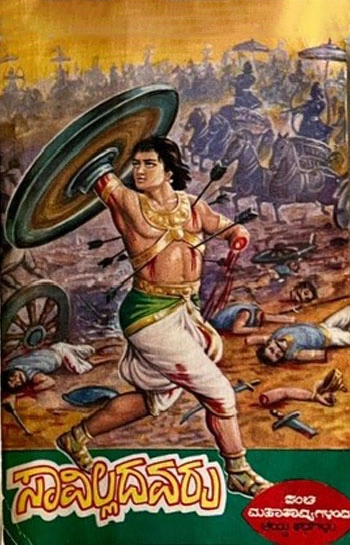
1982 - Saavilladavaru (Immortals) – Greek Story
This book ‘Saavilladavaru’ is the collection of ten stories selected from the ancient great epic poems (Mahaa Kaavya). This is the 25th volume of the World Stories Collection series (Vishwa Katha Kosha) pubished by “Navakarnataka Publishers”. The source is from the original Gilgamesh’s Veeragathe (heroic verses), Illiad, Ramayana and Mahabharata. Along with the original source, the writer has researched very many books related to those stories and narrated them. The subject for the stories was selected by the publisher and CKN wrote them.
About five thousand years ago, in ancient Shumer, in the middle region between the rivers’ Upratis and Tigrees, ‘Girlgamesh Veeragathe’ was created. This is the very first written world’s poem. The tragic hero of this Kaavya is ‘Gilgamesh’. Enkidu was the celestial hero. There was another character, a woman. The story is entwined around these three characters in rare circumstances. The “arrival of Entadu” and “deluge” have come from Gilgamesh’s Great Epic poem. The world first epic poem stories are fascinating or attracting in many different angles.
In 1000 BC, the stories created in Great Epic Poems written in Greek language are “Menelaus and Alexander’s Duel Battle” and “Hector’s Death”. These stories have their own themes and they would truly scintillate or attract the human’s natural behavior for heat of passion and frightful battles for all times to come.
The stories selected from one of the India’s ancient Great Epic Poems, ‘Ramayana’ about ‘agony of Dasharatha’ and ‘story of Vali’, are the familiar narrations to Indians. As well the original stories about ‘Droupathi’s vow’ and ‘Veera (Hero) Abhimanyu’ from the Great Epic ‘Mahabharata’ are also familiar.
In construction of all the stories, the writer has followed a unique method. The most famous story from each Great Epic has been selected. When narrating the story, it is written to keep the interest going by keeping the story together as well as by mentioning the background before and after substance. Even though the original story would not be familiar, nothing comes in the way to keep the interest to enjoy the story. By studying these stories, it would create more interest to study the original stories. Since all the stories are from the World’s
Great Epics, this would give enough materials to know about similar points, tactics and distinctiveness. The details on the rules and reasonings, conversations, dresses or attires, showiness, food and travels, all would bring back memories of the Emperors and Kings life times. The writing style is simple. The proverbs and conversations have flowed smoothly in the writer’s story style. The stories in “Saavilladavaru” would be enjoyed by all ages. The Title is very meaningful. Even though the heroes with the related characters die, their memories are immortal. These characters have been permanent for thousands of years. Even in the future, these characters would remain ageless. This collection of stories was published in 1982.