
From 1938 to 1952, translations of all six novels are listed as follows
- 1938 - Premayogini
- 1940 - DarpachoorNa
- 1941 - Arakshaneeya
- 1946 - Kaasheenatha
- 1957 - Vishweshwari
- 1958 - Mantra Deekshe
CKN translated Sharaschandra Chattopadhya's Bengali novels into Kannada
In Indian literature, the influence of Bengali literature on other Indian languages is indelible. Bengali novels have attracted all people in the literary field with affection. Either in its own language or in Kannada language through translation, Kannadigas have become familiar with Bengali novels. Certain Kannada writers, translating Bengali Novels into Kannada have made the Kannada literature richer. CKN is one such writer. CKN has translated six novels of the famous Bengali Novelist Sharaschandra Chatterji.
CKN has translated Sharaschandra Chattopadhya's novels into Kannada written in Hindi language. For this purpose, he studied on his own Hindi language with interest. From Sharaschandra’s novels, CKN’s art of writing stories has strengthened. In CKN’s books, this has been the reason for creating ideal characters (e.g. Revimayya’s character in Shantaladevi novel). This has been helpful in achieving the art of telling a story eloquently by safeguarding the surprise. The influence of Bengali Novels has been deep rooted in CKN’s novels.
Once when he thought of translating Sharaschandra Chattopadhya's novels, he studied all of his novels and articles with keen interest. Because of this, he sat for a higher level exam in Hindi Language, “Praveshika”, and passed it. Due to the translation of Sharaschandra’s novels, he became famous as a translator. His own literary writings became almost invisible because of the publicity received for this translated novels. Without doing injustice to the original work, preserving the Kannada culture, CKN has done his translation work. Like the way Bengali language has been translated to Hindi, Sharaschandra’s novels in Kannada have come out just the same. The readers have applauded the translated novels of Sharaschandra by CKN.
1938 - Premayogini
This is the story of a girl who dreamed of ideals in the marriage, failed and became a victim to many dangers.

1940 - Darpachurna
This intermingled story that happens between the characters who are the reflections of rich-poor and human-inhuman behavior.

1941 – Arakshaneeya:
Th subject of this story is about the marriage of a girl who is not wealthy, not bright and she was powerless. This story was translated in one week`s time and published in the memory of his father-in-law who passed away in 1941.

1946 - Kasheenatha:
This story is a testimony to a married life which would lead to hell when the husband doesn`t understand the wife or the wife doesn’t understand her husband.

1958 - Mantra Deekshe:
The married life and delicate feelings are expressed justifiably in this novel, Mantra Deekshe.

CKN's translated novels were the talk of the town. One day, while traveling by train from Mumbai to Bengaluru, CKN stopped at Hubballi station for dinner. Upon returning, he found someone occupying his seat, unfazed by the fact that it belonged to CKN. So, CKN had to continue his journey standing. It was then that Govinda Chulake from Dharwad's Manohara Grantha Mala approached him and asked, "Hey Nagaraja Rao, after translating 'Arakshaneeya,' which Saraschandra novel did you tackle next?"
As soon as the person who had taken CKN's seat heard about "Arakshaneeya," he quickly got up and said, "Are you the Nagaraja Rao who translated 'Arakshaneeya'? My apologies, please take your seat. I mistook you for someone else." It turned out he had read "Arakshaneeya."
CKN questioned him, "Even if I were someone else, how could you have taken their seat?"
The stranger replied, "I'm truly sorry. I won't do something like this again."
CKN didn't recognize the gentleman, but it was evident that his works had made an impact.
Despite minor errors pointed out by reviewers, they recognized the necessity of such translations. Both reviewers and admirers commended CKN's dedication to these works.
Translating Western Literature to Kannada
Translation of Western Countries Writer’s literary works to Kannada through English.
A Glimpse into Notable Translations:
-
1956 - Oh! Nanna Nechhina Naade
1966 - Thathamaavana Kanasu
1967 - Laos and Combodia
Oh! Nanna Nechhina Naade (Oh! My beloved country) - ಓ! ನನ್ನ ನೆಚ್ಚಿನ ನಾಡೆ
CKN with the use of Russian-English dictionary, studied the Russian words and used the synonym words to translate into Kannada with the purpose of conveying that the life of foreign land would also apply to us. The novel “Oh Nanna Nechhina Naade is based on Allan Peyton’s “Cry the beloved country”.
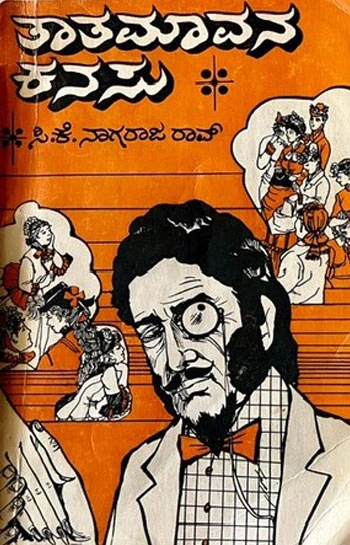
Thaathamaavana Kanasu: (Uncle’s dream) - ತಾತಮಾಮನ ಕನಸು
Tatamavana Kanasu’, a Novel translated by CKN in Kannada, is based on the Novel, ‘Dyadyushkin Son’ — My Uncle’s Dreams, written by the famous Russian Novelist, Fyodor Dostoevsky.
CKN has dedicated this novel as a symbol of India’s friendship to all the creative Russians who have crowned Fyodor Dostoevsky as the most renowned writer in world literature.
The following is from the forward in the Novel by CKN expressing his views to the readers:
“Dostoevsky (1821 - 1881 AD) is a famous Russian writer. He preceded Count Leo Tolstoy. The writer's pen is very sharp in satire. Similarly, there is also an inevitable pomp and show that complements sarcasm and sharpness. Therefore, the work of translation is very difficult. I have adopted a kind of style in translation that would align/match with the original style.
Perhaps for many it may look artificial. I have gone beyond my power to create the same effect as the original. If the kindhearted kannada people appreciate my translation, I would feel that my efforts have served the purpose.
As a result of some crazy values, how the society can become polluted and in turn become the basis for revolution can be understood if you read Dostoevsky’s works. It also makes us understand what a great writer can give such an excellent gift to the society.
Every country has its own literary history. When you look at that history from a comparative perspective, there are very few works that stand beyond the limits of time. But those that do stay like that should become part of a good literature that is understandable to all people of all countries.”
The plot and actions in Taatamaavana Kanasu inspired CKN so much that he wrote a dramatized Indianized play, "Sampanna Samaaja".
Laos and Cambodia - ಲಾವೋಸ್ ಕ್ಯಾಂಬೋಡಿಯಾ
CKN translated this novel, Laos and Combodia, into Kannada in 1967.
CKN did not get involved in translation works for a long time. For this, there are two reasons. The first one was increase in number of translators. The second reason was that repetitive mistakes were seen when many people started to translate the same novel.
Couple of translated works of CKN had been even eaten by termites or white ants as he could not find a publisher.